Your duty to report, and why you must never tip off
Summary
When a transaction must be reported, who decides and files, and why the member must never find out.
About 4 minutes · 7 steps. Also called: suspicious transaction reporting, STR, threshold reporting, tipping off.
Sign in with your email to read the rest of this article, track what you have finished, and earn your certificate.
Sign inPrerequisites
- The name of your compliance officer and a private way to reach them.
- Somewhere to record what you saw, with dates.
Step-by-step
Know your part first. You raise concerns inside your institution — no separate sign-in or filing is asked of front-line staff, and you never file with the authority yourself.
Learn the first trigger, size: a large cash transaction report is made when cash reaches the threshold your country sets. The member may be completely honest; the report is still made.
Learn the second trigger, suspicion. A suspicious transaction report is made when there is reason to think money comes from crime, or is moved to hide its source. There is no minimum amount.
Remember that suspicion is not proof. You need a genuine reason based on something you saw — not certainty, not a named crime, not gathered evidence.
Follow the route: you raise it, the compliance officer reviews and decides, and the institution files. In the monitoring tool, a suspicious case moves to pending report, then reported once filed.
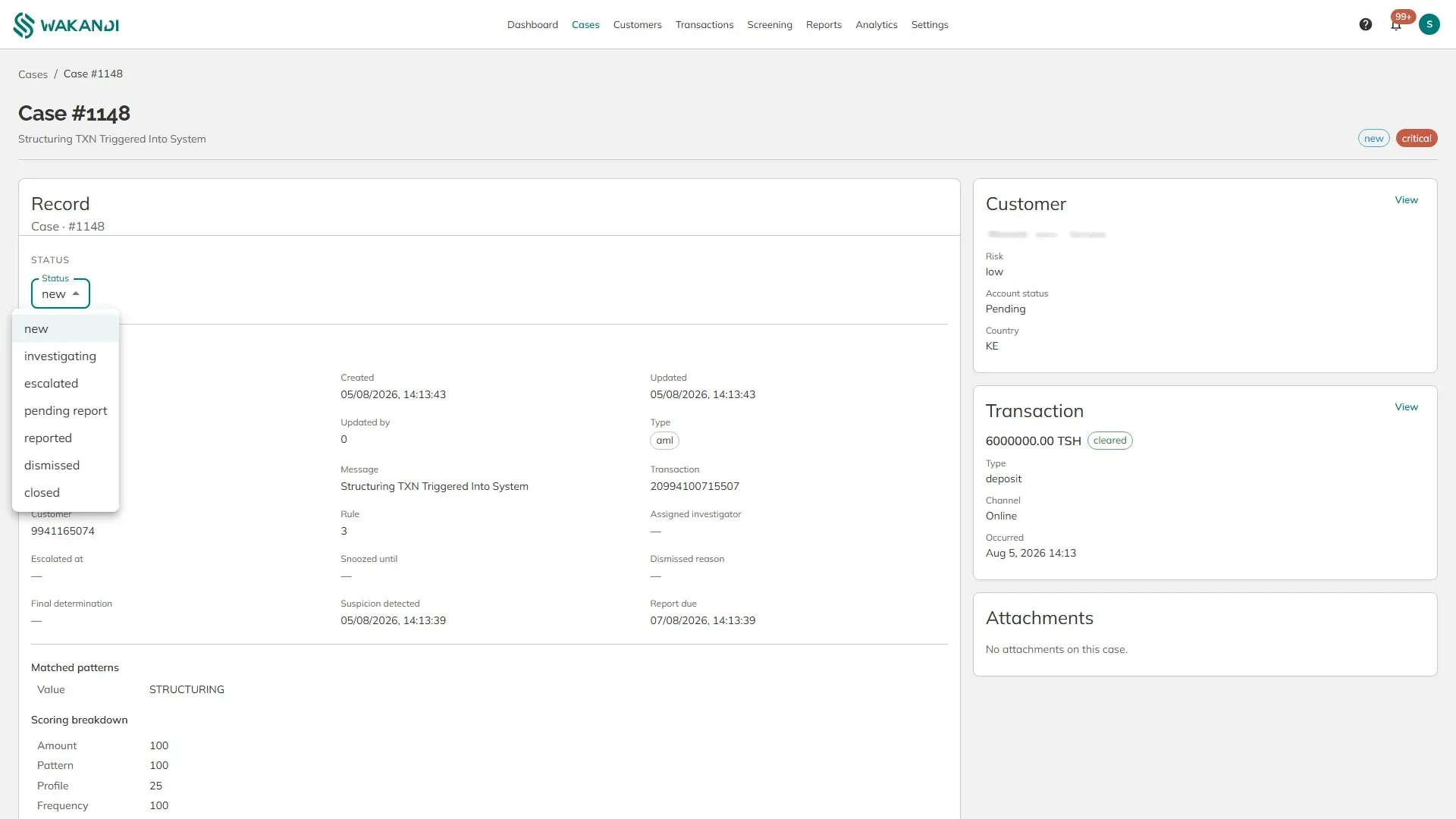
Figure 1: The status list on a case, where a suspicious case moves through pending report to reported Never tell the member. Telling them, or anyone outside the review, is tipping off — it gives the money time to move and papers time to disappear. Family, friends and uninvolved colleagues count too.
Behave normally while a case is open. Serve the member as you always do; a sudden change of manner tells its own story.
Tip: Record facts, not conclusions: what the member did, said and presented, with dates and amounts. Leave the judgement to the compliance officer.
Common pitfalls & FAQ
- "I should wait until I have proof." Proof is not your job. A genuine reason to suspect is enough to raise it internally.
- "The member is my neighbour, so it is fair to warn her." Warning her is tipping off, and the rules treat it seriously. Raise it with your compliance officer instead.
- "I raised a concern and heard nothing back." Silence is normal. A case is shared only with people who need to know, and that may not include you.
- "The whole branch should watch this member." Only staff with a role in the review are told. Wider talk is how a member finds out.