What money laundering is, and how it works
Summary
What money laundering is, how criminals do it in three stages, and why a savings institution sits in the middle of stage one.
About 3 minutes · 6 steps. Also called: laundering, dirty money, cleaning cash.
The first half of this course, lessons 1 to 10, is the knowledge every staff member needs: identification, due diligence, warning signs, reporting and records. The second half, lessons 11 to 18, is the Wakandi AML Risk Monitoring tool that turns that knowledge into daily work.
Sign in with your email to read the rest of this article, track what you have finished, and earn your certificate.
Sign inPrerequisites
- Nothing — no legal training and no system access. This is background for every staff member.
Step-by-step
Start with the meaning — there is no screen or sign-in in this lesson, only one idea. Money laundering is taking money that came from crime and making it look like it came from honest work. The crime comes first; laundering is the clean-up that follows.
Know why criminals need an institution. Cash from crime is hard to spend in large amounts without drawing attention. It has to pass through a bank, a SACCO or a mobile wallet, and come out looking like savings or business income.
Learn stage one, placement: getting the dirty cash into the financial system for the first time. In a SACCO it looks like cash deposits every few days, each below the threshold for extra checks, until the balance far outgrows the member's stated income.
Learn stage two, layering: moving the money around so nobody can trace it back. The deposits leave again quickly, split across other member accounts and mobile money numbers. It looks like traffic, not saving.
Learn stage three, integration: bringing the money out with a clean story attached. The member borrows against their own swollen savings, repays early, and now holds respectable loan paperwork to point at.
See where the course goes from here. Each stage leaves a pattern, and patterns can be watched for — the monitoring rules in the second half encode exactly these shapes.
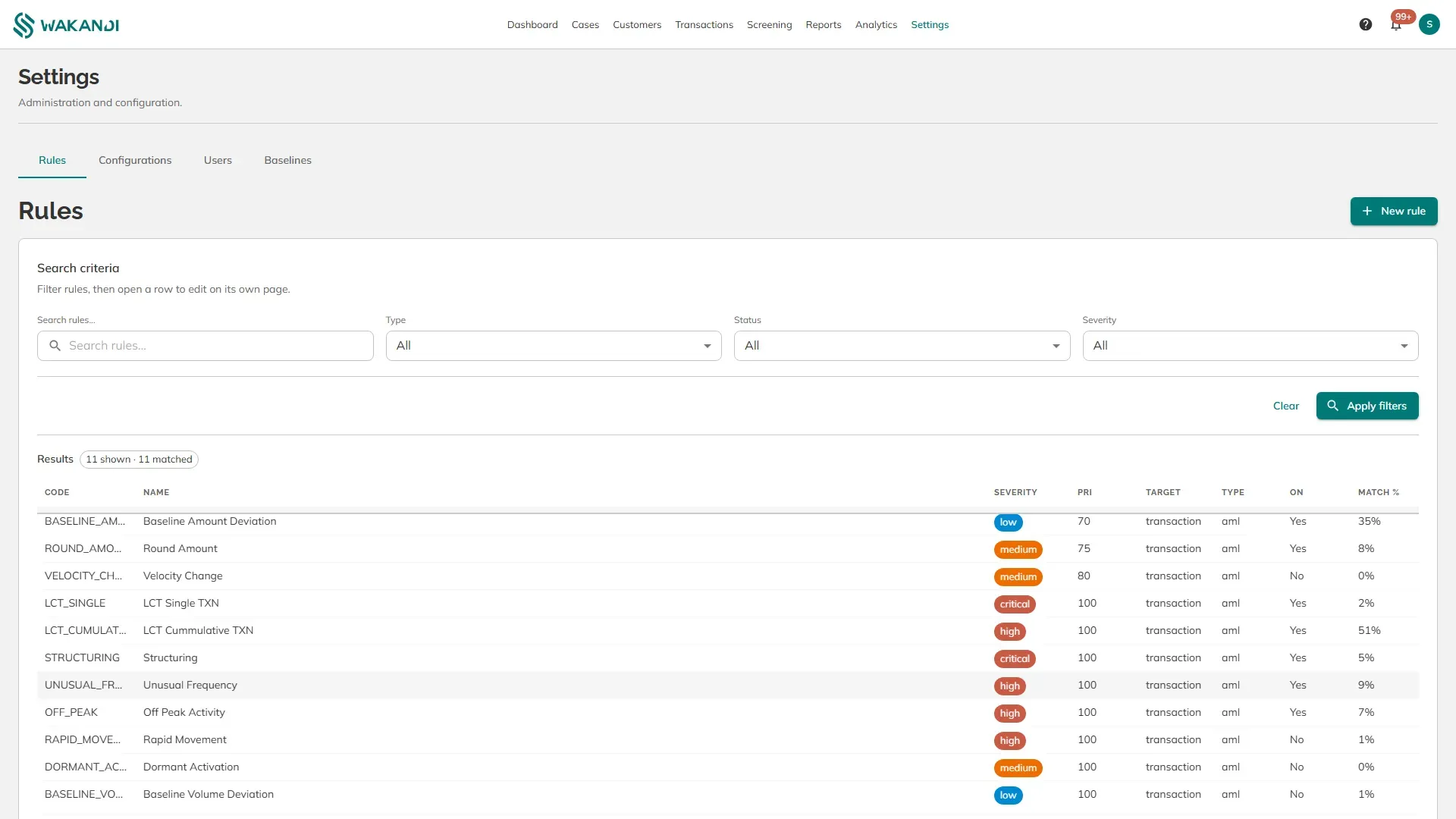
Figure 1: The Rules list in Wakandi AML Risk Monitoring, where the laundering patterns from this lesson appear as named monitoring rules
Note: AML rules differ by country. Your institution's policy and your compliance officer set the detail — every lesson in this course assumes that.
Common pitfalls & FAQ
- "Money laundering only happens in big banks." Small and rural institutions are often more attractive: fewer staff, familiar faces, fewer questions. The next lesson covers why.
- "Raising a concern accuses the member of a crime." It says the activity needs review by people trained to look. Many reviews end with an innocent explanation, and that is a normal outcome.
- "Only big amounts matter." Many small amounts kept under a threshold are a classic sign. Whether the activity fits the member matters as much as its size.