Financial statements and reporting to the Registrar
Every shilling a SACCO takes in and pays out ends up in its financial statements. Those statements, prepared honestly, checked by an auditor and reported to members and the Registrar, are how a society proves it is sound and well run.
Members entrust their savings to leaders they cannot watch every day, and the regulator licenses the society on the strength of the numbers it files. Late, incomplete or inaccurate accounts erode trust, invite penalties and can put the SACCO's registration at risk.
The three core statements
A complete set of annual accounts rests on three statements, each answering a different question:
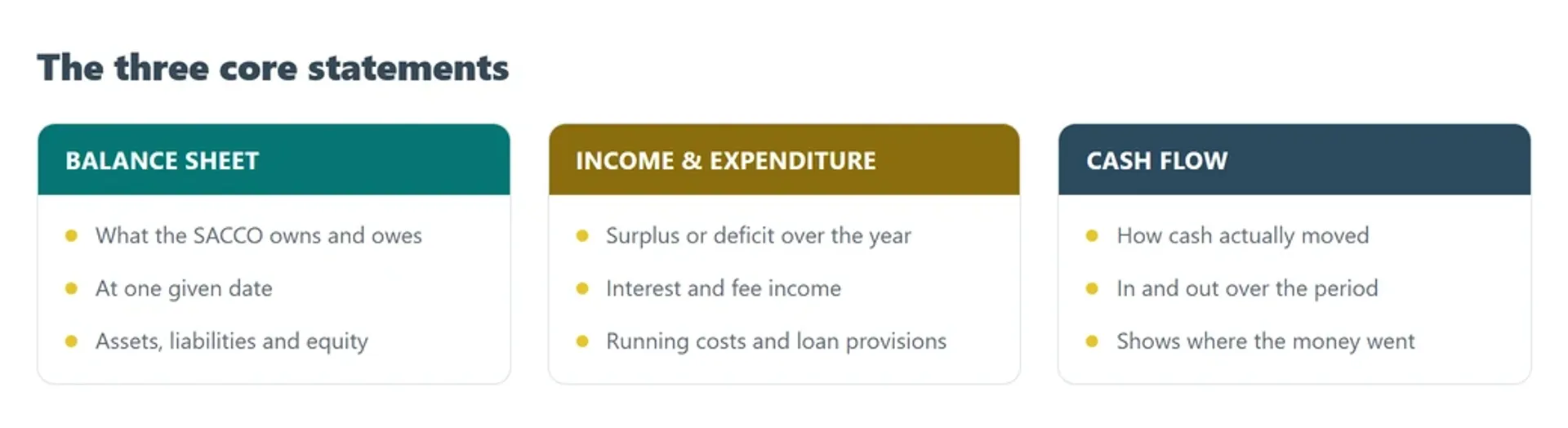
- Balance sheet (statement of financial position): what the SACCO owns and owes on a given date, meaning members' shares and deposits, loans outstanding, cash, assets, reserves and liabilities. Assets must equal liabilities plus members' funds.
- Income and expenditure statement: the surplus or deficit over the year, that is, interest earned on loans, fees and other income, less interest paid on deposits, salaries, provisions for bad loans and running costs.
- Cash-flow statement: how cash actually moved in and out over the period, so leaders can see whether the society can meet its obligations, not just whether it is profitable on paper.
Preparing the annual accounts
Good statements are built on good records kept all year, not assembled in a rush at year-end.
- Reconcile the cash book, bank statements and member ledgers every month so errors surface early.
- Post transactions promptly and keep the supporting vouchers, receipts and bank slips filed and traceable.
- Make a realistic provision for loans at risk so the surplus is not overstated.
- Draw up the draft accounts soon after year-end, ready for the auditor.
Keep a fixed-asset register
Every SACCO should maintain a fixed-asset register listing each significant asset (motorcycles, computers, furniture, land and buildings) with its purchase date, cost, location, depreciation and current book value. Verify it against the physical assets at least once a year. The register supports the balance-sheet figures, deters theft and gives the auditor confidence that what is on the books actually exists.
The external audit and the AGM
An independent external auditor, appointed by the members at the AGM, examines the accounts and gives an opinion on whether they show a true and fair view. Once audited, the accounts are presented to members at the Annual General Meeting. The leadership talks members through the balance sheet and income statement, answers questions, and the meeting formally adopts the audited accounts before any dividend is approved. (See the separate article on internal and external audit for detail.)
Statutory returns to the Registrar
Beyond the annual accounts, the SACCO must file statutory returns to the Registrar of Cooperatives (the Mrajis) and, where it applies, the central bank or delegated microfinance authority:
- Monthly: key returns on savings, deposits, loans and liquidity, filed by the due date.
- Quarterly: summarised financial and performance returns as required by the supervisor.
- Annually: the audited financial statements, the auditor's report and the annual return, filed within the statutory deadline after the AGM.
File on time, keep a copy of every submission, and reconcile each return to your ledgers before sending it.
Quick checklist
- Monthly reconciliations of cash book, bank and member ledgers are done and filed.
- The fixed-asset register is complete, depreciated and verified against physical assets yearly.
- Draft accounts are ready promptly for an auditor appointed by the members.
- Audited accounts are presented to and adopted by members at the AGM.
- Monthly, quarterly and annual returns are filed with the Registrar/regulator by their deadlines.
- A copy of every statement and return is retained, reconciled to the ledgers.