What CAMS monitors for money laundering
Summary
What Wakandi watches for on your members' transactions, who controls the thresholds, and what falls outside it.
About 3 minutes · 3 steps. Also called: AML, transaction monitoring, compliance, anti-money laundering.
Sign in with your email to read the rest of this article, track what you have finished, and earn your certificate.
Sign inPrerequisites
- A sign-in for Wakandi AML Risk Monitoring, a separate service from CAMS, created for you by an administrator.
Step-by-step
- Open Wakandi AML Risk Monitoring and sign in. You land on the dashboard.
- Read the four cards along the top for anything urgent.
- In the top menu, click Settings to see the rules behind it all.
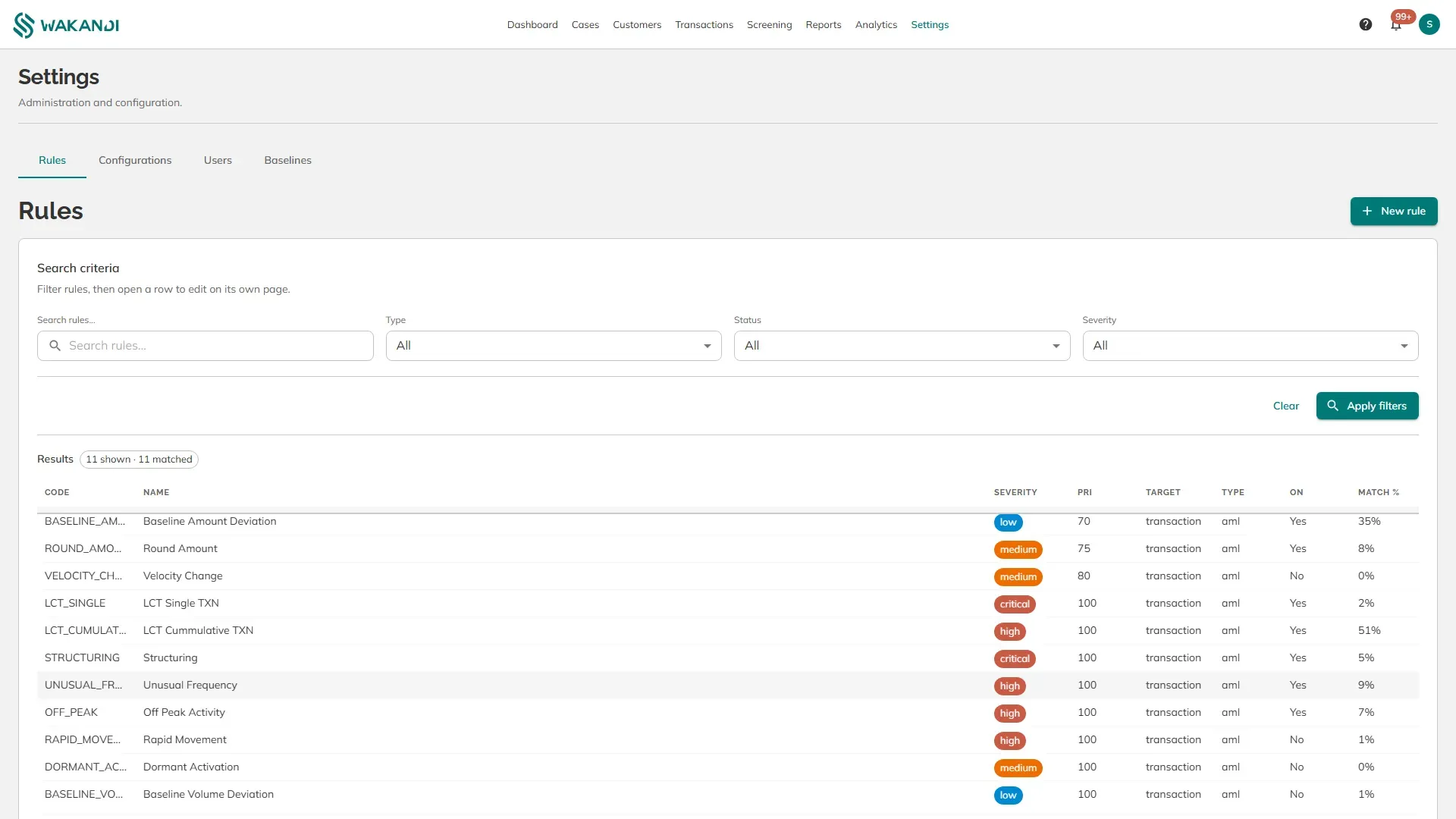
How it works. Transactions your members make in CAMS are passed to AML Risk Monitoring and checked against a set of rules. When one matches, the system opens a case for your compliance team and can notify people by email and SMS. Nothing is blocked or reversed; the system raises the question and a person answers it.
Eleven rules. Some look for a fixed limit being passed, such as a large cash transaction. Some look for a shape, such as a large sum split into smaller pieces. Others compare a member against their own normal behaviour, so a trader moving large sums daily is not flagged for doing exactly that.
Your values, your decisions. Thresholds, deadlines and windows belong to your institution; a compliance administrator sets them under Settings → Configurations and changes them as policy changes.
Screening. Names can be checked against international sanctions lists and against a local list your institution keeps itself.
What is not covered. Only member transactions are monitored. General ledger income and expense postings do not create cases, so routine accounting entries stay out of the queue.
Note: Each rule that matches a transaction opens its own case, so one transaction can produce several. That is why the case count runs higher than the transaction count behind it.
Common pitfalls & FAQ
- Does this stop a suspicious transaction? No. It records a case for a person to review; it monitors, it does not block.
- Can I use my CAMS password? No. AML Risk Monitoring has its own sign-in. Ask an administrator to add you under Settings → Users.
- Who decides the thresholds? Your compliance officer, following your country's rules. Agree them before entering anything.
- We see far too many alerts. Start with Analytics → Rule performance to find the rule producing them, then review that rule's threshold rather than the members.