Pricing a loan: fees, interest and penalties

The price of a loan is more than its interest rate. It is the fees, the interest method, the penalties and the repayment period all taken together, and members deserve to see the whole picture before they sign.
Why it matters: a member who understands exactly what a loan will cost repays with confidence and comes back for more. Hidden charges, a confusing interest method or harsh penalties breed mistrust, disputes and default, and they damage the reputation of a society the members themselves own.
Where the money to lend comes from
Your loan fund is built from members' own savings and shares. When a member borrows, they are borrowing the pooled deposits of their fellow members, so every loan must be priced to protect that fund, not to punish the borrower.
- Lending capital comes chiefly from members' savings, deposits and share capital.
- Income from interest and fees keeps the fund healthy and pays for running the SACCO.
- Because members fund the loans, fair pricing is a duty to the whole membership, not just good manners.
Processing fees and charges
A modest fee covers the real cost of appraising and administering a loan. Keep it simple and openly stated.
- Charge a clear, reasonable processing fee, a small percentage of the loan or a flat amount, set in your loan policy.
- List every charge (application, insurance, legal or valuation where relevant) so nothing is a surprise.
- Avoid stacking small fees that add up to a large, hidden cost. Members notice, and trust erodes.
The interest method: reducing-balance vs flat rate
How you calculate interest matters as much as the rate itself. There are two common methods, and they are not equal.
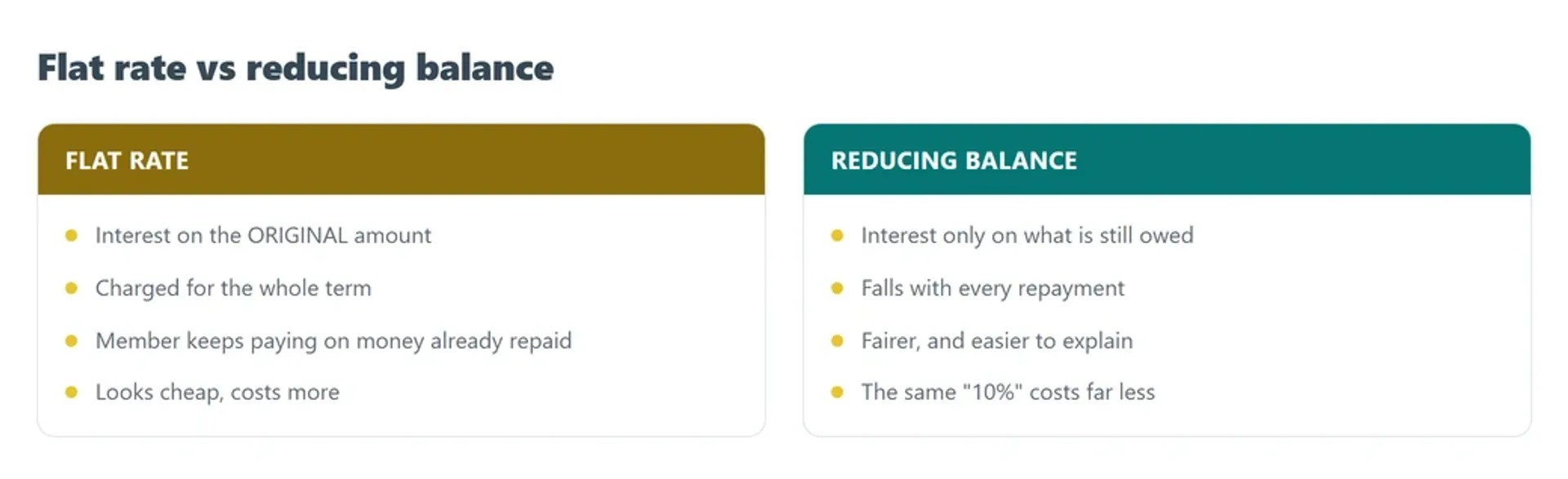
- Flat rate charges interest on the original loan amount for the whole term, so the member keeps paying on money they have already repaid.
- Reducing balance charges interest only on the amount still owed, which falls with every repayment.
- Reducing balance is fairer and clearer. The same "10%" costs the member far less on reducing balance than on flat rate. Prefer it, and if you must quote a flat rate, always show the equivalent reducing-balance cost too.
Penalties for late repayment
Penalties should encourage repayment, not trap the member in a spiral of debt.
- Disclose the penalty up front (the amount or rate and when it applies) in the loan agreement.
- Keep it fair and proportionate, charged on the overdue amount only, never on the full loan.
- The goal is to bring the account back on track, not to profit from a member's hardship. Speak to a struggling member before penalising them.
Repayment period and total cost
- Set a maximum repayment period in your loan policy and match the term to the loan's purpose and the member's ability to repay.
- Before disbursing, give the member the total cost of the loan: principal, all fees, total interest and the full amount repayable.
- Provide a repayment schedule showing each instalment and the shrinking balance, so the member can plan.
Quick checklist
- Interest is charged on the reducing balance, not a flat rate.
- Every fee and charge is listed and reasonable, with nothing hidden.
- Late-payment penalties are disclosed, fair and charged only on the overdue amount.
- A maximum repayment period is set and the term suits the member's capacity.
- The member receives the total cost and a full repayment schedule before signing.
- Pricing protects the members' savings that fund the loan.