Developing a new loan product

A new loan product should never start with "let's launch a new loan." It should start with a member need you have actually observed, and end with a product that is priced for its risk, approved by your board or credit committee, written into your policy, and watched closely after launch. Rushing that journey is how SACCOs end up with a product that loses money quietly for a year before anyone notices.
Why it matters: a loan product designed on a hunch and launched without controls can grow your book fast and your losses faster. Get the process right and every new product strengthens the SACCO instead of exposing it.
Start with the member need
Do not design in a boardroom. Find out what members are actually short of.
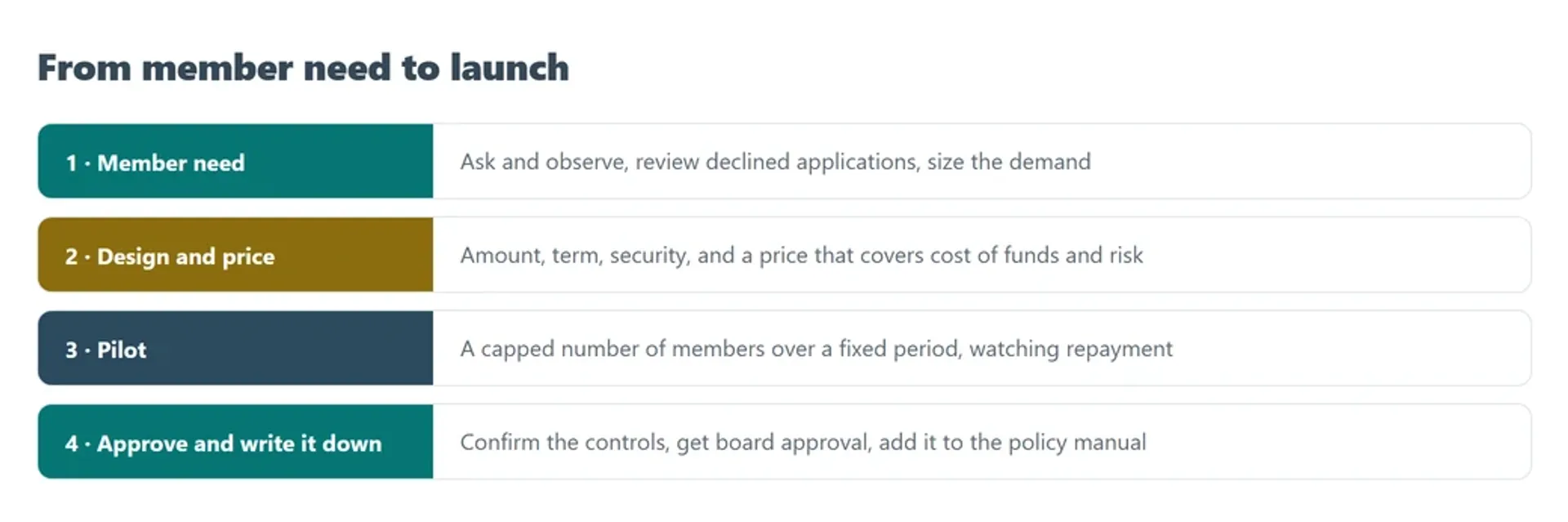
- Ask and observe. Talk to members, review declined applications, and look at where they borrow outside the SACCO (school fees, farm inputs, emergencies).
- Size the demand. Estimate how many members would use it and how often, so you know the product is worth building.
- Define the purpose: one clear reason for the loan. A product that tries to be everything is hard to price and easy to abuse.
Design the product and price for risk
Turn the need into concrete terms the board can approve and CAMS can enforce.
- Amount and term: sensible minimums and maximums, and a repayment period that matches how the member earns (harvest, salary, business cycle).
- Security: guarantor and collateral rules suited to the risk. An emergency loan and a business loan should not carry the same conditions.
- Price for risk. Set the interest rate and fees to cover your cost of funds, your operating cost, and the expected losses. A riskier product must earn more, or it drains the others.
Pilot before you launch
Test the product on a small, controlled group before opening it to everyone.
- Run a limited pilot: a capped number of members over a fixed period, so a design flaw costs you little.
- Watch repayment behaviour. Did members repay as expected, or did the terms invite arrears?
- Adjust, then decide. Refine the amount, term or pricing based on what the pilot showed, and only scale what worked.
Approve it, then write it down
No product goes live on a manager's say-so.
- Review the controls. Confirm eligibility, approval limits, and appraisal steps are clear before sign-off.
- Get formal approval. The credit committee or board approves the product and the pricing, and the decision is minuted.
- Document it in policy. Add the product to your loan/credit policy with its terms, and update the supporting policies: appraisal and process, borrower follow-up, an internal rating or scoring approach, and delinquency management.
Monitor performance after launch
Approval is the start of the work, not the end.
- Track uptake: is the product being used as expected?
- Watch PAR. Monitor portfolio at risk for this product on its own, not just for the whole book.
- Check profitability. Confirm the income covers the losses and costs, and review the product at least yearly through the board.
Quick checklist
- Confirm the member need with real evidence, not assumption
- Set amount, term, security and a price that reflects the risk
- Run a small pilot and adjust before scaling
- Get board/committee approval and minute the decision
- Write the product into your loan policy and update supporting policies
- Monitor uptake, PAR and profitability, and review yearly